
Break once, it’s okay. Break twice, it’s a pattern.

What if I told you this is a lie?

On 1 January 2026 I went all in on one question: what does it take to build consistent habits when life is busy and messy?

I don’t have a single streak. I’ve broken it once. Twice. Far more than twice. And I am more consistent than I have ever been.

Join the community

Day 270 of 365 · 95 to go

Price goes up after we hit 25 members.

Portrait of Tina Nayak in a green dress, leaning on a plinth in soft daylight
hi, I’m Tina
I track the honest dots. The good days, the hard days and the days I begin again.
242 days
still
coming back
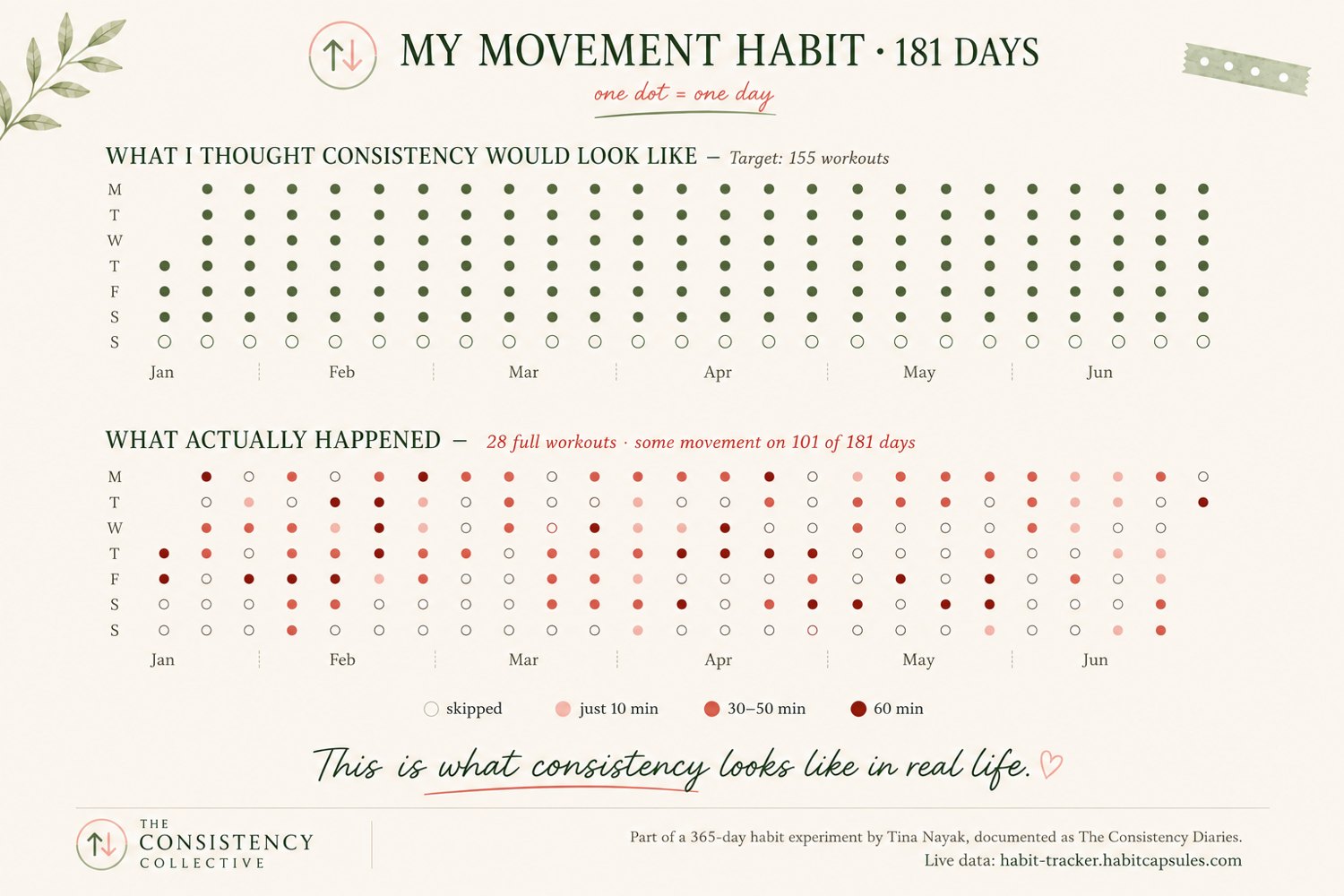
Two dot grids comparing my movement habit over 181 days. The plan was 155 workouts. What actually happened was 28 full workouts and some movement on 101 of 181 days.
My movement habit, 181 days. The plan on top. What actually happened underneath. Still the most consistent I have ever been.
242days tracked, in public
237days I showed up
5days I did not — and came back
2.4daverage time to come back

behind the scenes

Field notes from a beautifully messy year.

Each entry has one job: show the moment, name what happened, and share the lesson. Skim the pictures or stay for the story.

Tina Nayak's Ship-It weekly planner on a desk beside a mug, where the habit tracking started

one question, one honest start

Journal 01 · The start

Could kindness make me more consistent?

I kept picking habits that looked good on someone else. Then I blamed myself when they did not stick. Every system I tried asked me to be a woman with more time, more energy and fewer people needing her. So I started a public experiment instead.

The tiny rep: show up in any size that fits the day.

What I learned: starting small is not cheating. It is how trust begins.

Meditation · one dot per day · Jan–Aug 2026

Meditation habit tracker, 242 days
did it did not

60 of 242 — and August was my best month

Journal 02 · The evidence

The gaps did not erase the work.

The dots were never neat. They were useful. They showed me when to push, when to make a habit smaller, and when to let one go.

Meditation took 8 months to crack. 3 days in January. 3 in March. I kept logging it anyway. In August an old audiobook came back to me. I tried it lying down and I was under in seconds. 16 days that month.

Inside the community we work with the subconscious to build new habits and let go of the ones that stopped serving you.

What I learned: count comebacks, not streaks. See all 242 days →
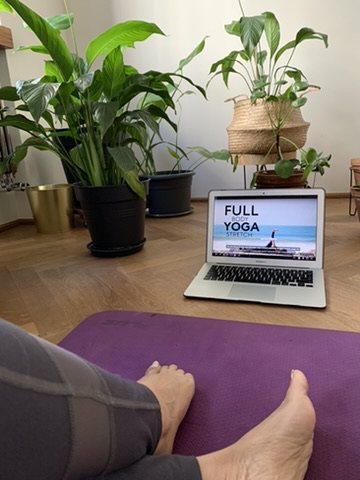
Tina Nayak travelling in Japan, a holiday where no routine held A yoga mat unrolled at home in front of a laptop playing a yoga stretch video
Journal 03 · Real life

Some days, the win was simply returning.

Surgery. A family emergency that derailed every plan. Travel while sick. A vacation in Japan where I could not work out at all. My movement habit has 6 shapes. Yoga, strength, badminton, tennis, a walk, or 10 squats on the worst day. I never have to skip. I only have to choose.

What it proves: consistency can bend without breaking.

the idea

What is Compassionate Consistency?

Compassionate Consistency is building habits through kindness instead of punishment. You do not count streaks. You count comebacks. You make a habit smaller until it fits the life you actually have, and you keep changing its shape until you find a version you enjoy.

Missing a day is not failure. Quitting after a missed day is. A habit that feels like punishment will not survive, so the work is not more willpower. It is a better fit.

I named this after 8 months of testing it on myself, in public, with every honest number on show.

  • Habits have seasons. Some months you push. Some you hold on. Both count.
  • A habit needs a strong why, or it will quit on you.
  • Build 1 habit 6 different ways, so you never have to skip.
  • Count comebacks, not streaks. A streak breaks once and you are done. A comeback can happen every day for the rest of your life.
  • Some habits are meant to end. Retiring one is information, not failure.

the accountability part

Why join The Consistency Collective?

Belief is built alone. Practice is not. Here is what happened to the women who stopped doing it by themselves.

Inside the community we work with the subconscious to build new habits and let go of the ones that stopped serving you.

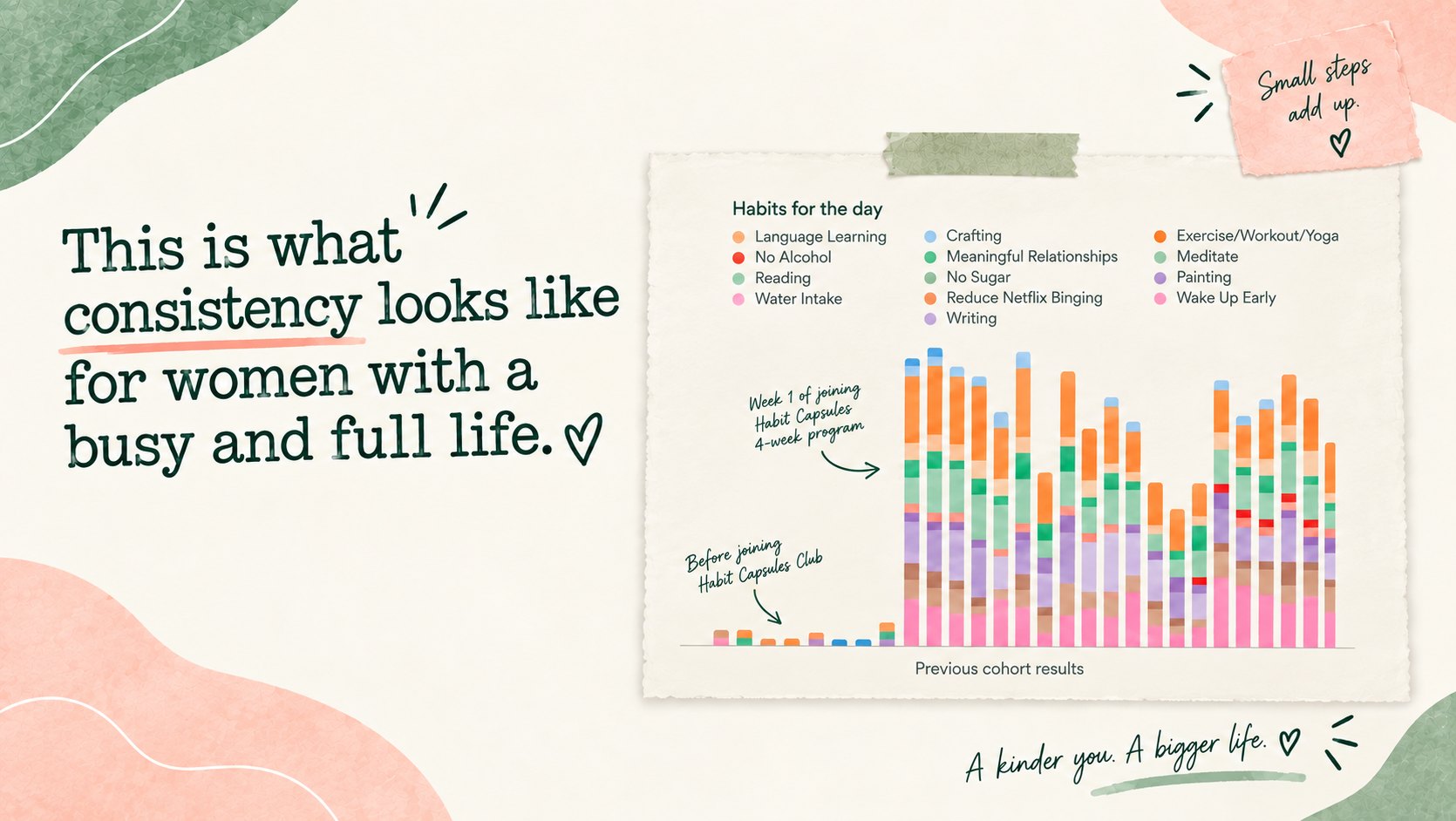
Chart of a previous Habit Capsules cohort. Before joining, a handful of small habit bars. From week one of the four-week programme, tall stacked bars every day across exercise, meditation, reading, writing, water, waking early and more.
A previous cohort. The left is before joining. Everything after is week one onward.
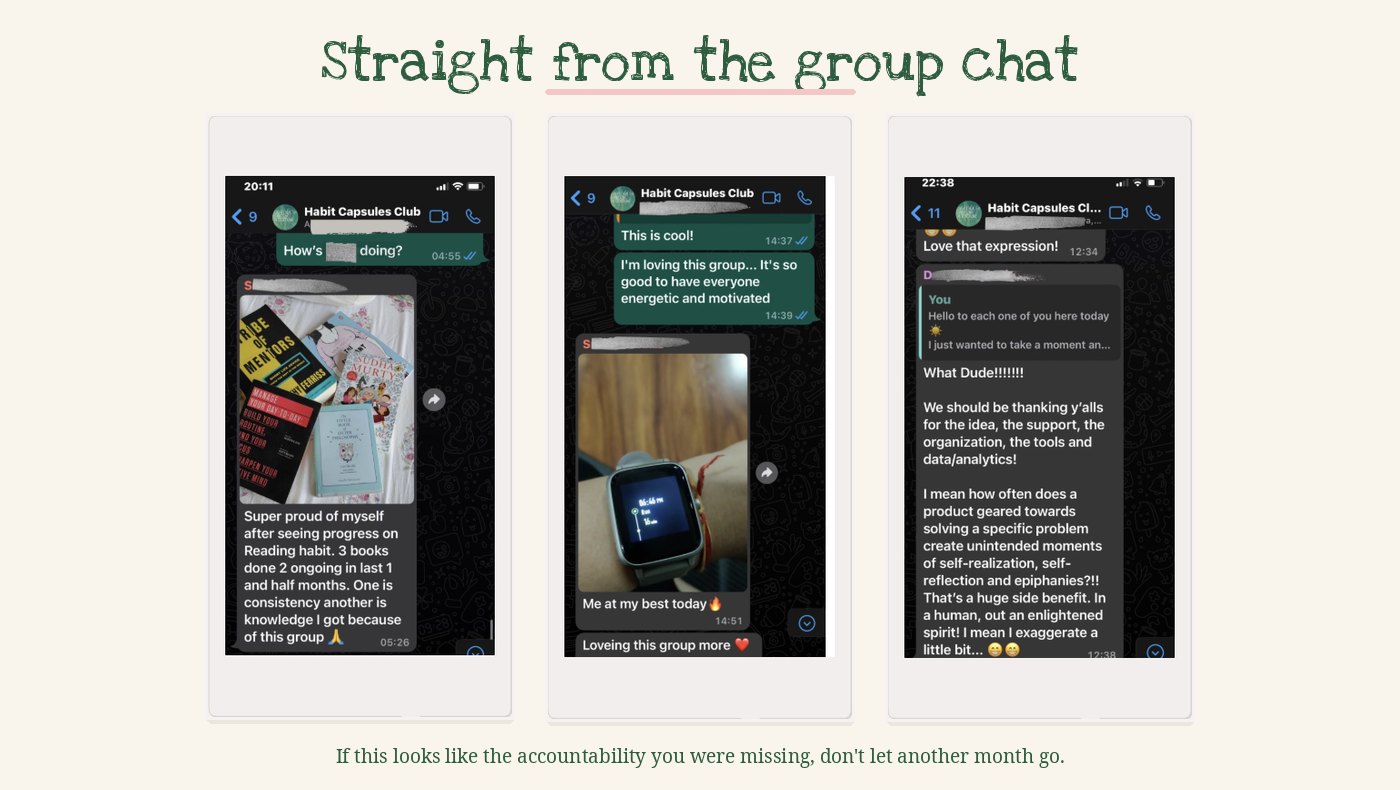
Three WhatsApp screenshots from the Habit Capsules Club group chat: a member proud of finishing three books, a member loving the group's energy, and a long message thanking the group for unexpected self-realisation.
How the last cohort described themselves afterwards. Their words, not mine.

This is what real consistency looks like when you have a community and someone expecting you.

Lock in your spot

Become joyfully consistent. And unstoppable.

From my journal to your practice

You do not have to figure out your comeback alone.

The community gives people a place to practise imperfectly: reps after reps, kind accountability and help when life gets busy.

Joining early is genuinely different. While the group is small you get my time directly. Personal answers, and habits shaped around your life instead of general advice.

A women-only community. No judgment, no streak shaming, no pretending anyone is perfect.

honest answers

Questions I get asked

Why can’t I stay consistent?

Usually because the habit does not fit the life you actually have, or there is no strong reason underneath it. Motivation gets you started. Fit is what keeps you going.

I spent 8 months failing at meditation. 3 days in January. 5 in February. 3 in March. I did not need more discipline. I needed a version of the habit I could do on a bad day. When I found it, August became my most consistent month of the year.

How do you stay consistent when life breaks your routine?

You give the habit more than one shape. My movement habit has 6: yoga, strength training, badminton, tennis, a walk, or 10 squats on the worst day. I never have to skip. I only have to choose.

In 242 tracked days I got through surgery, a family emergency that cancelled every plan, travel while sick, and a holiday in Japan where I could not work out at all. I was active on 237 of those days. Not because the routine held, but because the habit could bend.

How do you stay consistent with working out?

Make the smallest version non-negotiable and let the size float. On a good day that is a full session. On a hard day it is a 10-minute walk. Both count as showing up.

My fitness numbers swung wildly. 173 Habit Capsules in July, 92 in August. Neither month was a failure. July I had just got home and wanted the routine back. August I was deep in writing. The habit survived both because it was allowed to change size.

Does missing one day break a habit?

No. Research by Lally and colleagues (2010) found a single missed day does not meaningfully disrupt habit formation. Quitting after a missed day is what breaks it.

That is why I measure a Resilience Score: how many days it takes me to come back, instead of streak length. Mine is 2.4 days. A streak can only ever break. A comeback can happen every day for the rest of your life.

How do you stay consistent and motivated at the same time?

You mostly do not, and that is fine. Motivation shows up unreliably. What I rely on instead is evidence.

After 8 months of tracking, I know I come back. So when I step away from a habit now, I am not afraid. I am confident. Those are two completely different ways to live. One is running on a wheel because you are scared to break the chain. The other is stepping back on purpose, knowing you will return.

What is Compassionate Consistency?

Compassionate Consistency is building habits through kindness instead of punishment. You do not count streaks. You count comebacks. You make a habit smaller until it fits the life you actually have, and you keep changing its shape until you find a version you enjoy.

The founding idea is simple: a habit that feels like punishment will not survive. So the work is not more willpower. It is a better fit. I named it after 8 months of testing it on myself, in public, with every honest number on show.

What is a Habit Capsule?

One small, repeatable unit of a habit, sized so you can finish it on your worst day. 5 minutes of meditation is one Habit Capsule. 10 minutes of movement is one. 15 minutes of writing is one.

Counting capsules instead of hours means a hard day still puts something in the bank. Over 242 days I have banked 3,359 of them.

Is it okay to give up on a habit?

Yes, and knowing which one to drop is rarer than knowing which one to add. I have retired 3 this year.

A habit with no joy and no real pull behind it will fall away whatever you do. That is information, not failure. Sometimes a habit ends because it grew into something bigger. Mine turned into writing, YouTube and Instagram instead.